Why This Matters Now
Enterprise AI is
entering a more mature phase. Business and technology leaders are no longer asking only
whether AI should be adopted; they are asking where it can improve performance, how it
can be governed, and how quickly it can be translated into operational value. Across
industries, organisations are balancing the need to modernise legacy applications,
reduce manual effort, improve customer and employee experiences, and meet increasingly
complex regulatory requirements.
The direction
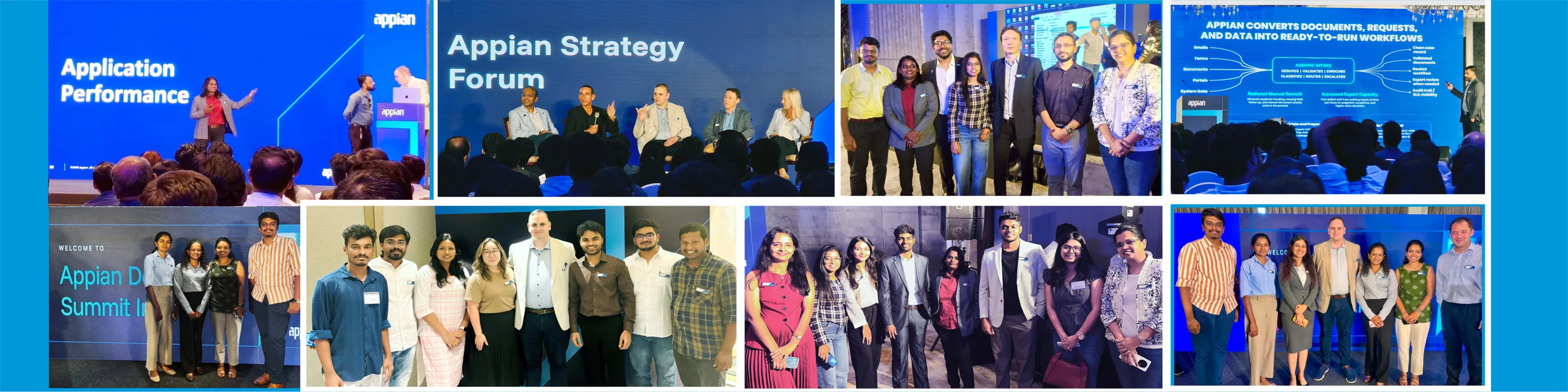
shared at Appian DevDay reflects this shift. AI is being embedded across the application
lifecycle—from design and development to deployment, monitoring and ongoing
modernisation. This creates a more connected model in which low-code development,
process automation, data and AI work together rather than operating as separate
initiatives.
For clients, the
significance is practical: development teams can move faster, operations teams gain
better visibility, and business leaders can introduce AI selectively in the areas where
it improves outcomes. That process-first approach is particularly important in regulated
and mission-critical environments, where speed must be balanced with reliability,
security and human oversight.
1. AI-Powered Development with Developer Agents and
Plugin Composer
Developer Agents
leverage AI to help modernise existing Appian applications by identifying legacy design
patterns and evolving functions. The initial focus is on helping development teams
recognise outdated approaches and move applications towards current Appian best
practices, with data modernisation expected to become part of future capabilities.
Plugin Composer
extends the same principle to custom development. Using natural language prompts, it can
generate production-ready Appian plugins and reduce the need for manual SDK coding in
many scenarios. This can remove repetitive implementation work, shorten the path from
requirement to working component, and make specialised development more accessible to
delivery teams.
The business
value goes beyond developer productivity. Faster modernisation can reduce technical
debt, improve maintainability and allow organisations to benefit from new platform
capabilities without committing to a complete rebuild. For clients with large Appian
estates, this can support a more continuous and lower-risk modernisation model.
In banking and
insurance, this may help teams update long-running onboarding, claims or compliance
applications. In the public sector, it can support the gradual improvement of
citizen-service platforms. In manufacturing and healthcare, it can help modernise
operational applications while preserving business continuity.
2. Modernising Legacy Applications Without Starting
Over
Many enterprises
rely on applications that have evolved over several years. These systems may still
perform critical functions, but older design patterns, deprecated components and
accumulated technical debt can make enhancement slower and maintenance more complex.
The
forward-looking reverse engineering capabilities discussed at DevDay point towards a
more incremental approach. AI-assisted analysis can help identify deprecated
implementations and recommend how they should be converted to current Appian practices.
Instead of treating modernisation as a one-time replacement programme, organisations can
make it part of the normal application lifecycle.
This is
particularly relevant where downtime or disruption carries a high business cost. A
financial institution cannot simply pause regulatory operations while a platform is
rebuilt. An insurer cannot interrupt claims processing. A public-sector organisation
must continue serving citizens while its systems evolve. Incremental modernisation helps
protect continuity while improving long-term platform health.
For clients, the
benefit is a clearer path to future-readiness: lower maintenance risk, improved
developer experience, easier adoption of new features and a more sustainable return on
existing Appian investments.
3. AI Composer: Finding the Right Place for AI
AI Composer
introduces a dedicated AI capability that analyses an application and recommends where
AI Agents could be integrated based on the application's implementation and business use
cases. Rather than asking teams to begin with a blank AI strategy, it helps connect
potential AI use cases to the way an application already works.
One of the
strongest themes from the sessions was that not every process needs AI. Some tasks are
best addressed through deterministic automation. Some decisions can be improved through
AI-assisted analysis. Others still require human judgment, particularly where
exceptions, risk or customer impact are involved.
A practical
starting point is to separate repetitive work from judgment-based work. Data entry,
routing, reconciliation and routine validation may be strong candidates for automation.
Classification, summarisation, recommendation and pattern detection may benefit from AI.
High-risk decisions, unusual exceptions and sensitive customer interactions may still
need a human in the loop.
This matters
across industries. In financial services, AI may support investigation summaries while
analysts retain final decision-making authority. In insurance, it can assist with claims
triage without removing expert review. In healthcare, it can organise information while
clinicians remain responsible for care decisions. The value comes from applying the
right capability at the right stage of the process.
4. Dynatrace Integration and End-to-End
Observability
Appian has
partnered with Dynatrace to provide end-to-end observability across Appian applications.
The integration is designed to give teams deeper visibility into application performance
and user interactions, enabling proactive monitoring, faster issue identification and
quicker remediation.
As enterprise
applications become more connected and AI-enabled, observability becomes increasingly
important. A process may depend on multiple systems, APIs, data sources and automated
decisions. When performance slows or a user journey breaks, teams need to understand
where the issue originated rather than relying on fragmented troubleshooting.
For
business-critical environments, this can improve reliability and reduce operational
risk. Banks can monitor transaction and servicing workflows, insurers can track claims
and underwriting journeys, and public-sector teams can identify bottlenecks in
high-volume citizen services. Better visibility also supports stronger service-level
management and more informed capacity planning.
For clients, the
result is not simply better technical monitoring. It is greater confidence that
applications can be scaled, supported and optimised as usage grows.
5. Release Operations and More Structured Deployment
Release
Operations enables teams to create and manage releases, organise deployment packages and
deploy them to target environments in a structured manner. A key takeaway from the
sessions was that Appian's native Compare & Deploy process can provide a smoother and
more controlled experience than deployment workflows that depend heavily on external
GitHub processes.
Release
management is often where otherwise successful development programmes encounter
avoidable risk. Inconsistent packaging, unclear dependencies and manual coordination can
create delays or introduce defects into production. A more structured native approach
can improve visibility across what is changing, where it is being deployed and how
releases are governed.
For organisations
operating across multiple applications, teams and regions, this supports repeatability
and stronger controls. It can be especially valuable in regulated industries where
traceability, segregation of duties and auditable deployment processes are important.
Clients can
benefit from faster releases, fewer deployment errors, simpler governance and a clearer
path from development to production.
6. Model Context Protocol Integration
Appian now
supports the Model Context Protocol, enabling system administrators, developers and end
users to securely connect external AI applications with Appian capabilities. The Appian
MCP Server is currently available for Appian Cloud environments.
MCP provides a
standardised way for AI tools to access approved context and capabilities. In an
enterprise setting, this can help external AI applications interact with Appian
workflows, data and services without relying on ad hoc integrations for every use case.
The opportunity
is significant, but governance remains central. Organisations need to control which
systems an AI tool can access, what actions it can perform and how information is
protected. Appian's support for MCP creates a foundation for connected AI experiences
while keeping enterprise security and permissions in view.
Potential
applications include AI assistants that retrieve case information, support service
agents, initiate approved workflows or help developers interact with application assets.
For clients, this can make AI more useful because it becomes connected to real processes
rather than operating as an isolated conversational layer.
7. Intelligent Document Processing: Start Simple and
Scale with the Business Case
The Intelligent
Document Processing session emphasised a simple and cost-effective approach to
extraction. Teams were advised to configure only the fields that are genuinely required,
choose between Text and Visual extraction based on the document type, select an
appropriate layout configuration, and apply validation and guardrails where needed.
The
recommendation was to begin with the simplest configuration and introduce Visual
Extraction, Advanced Layout or LLM-based Validation only when the business case
justifies the additional AI processing cost. This is an important implementation
principle: a more complex model is not automatically a better model if a simpler
approach can meet the required accuracy and control levels.
The applications
are broad. Banks can use IDP for KYC documents, lending applications and regulatory
submissions. Insurers can process claims forms, policy documents and supporting
evidence. Healthcare organisations can handle patient onboarding and administrative
documentation. Public-sector agencies can digitise permits, applications and citizen
forms, while manufacturers can streamline invoices, supplier records and quality
documentation.
For clients, this
approach improves the economics of document automation. It helps control processing
costs, reduces unnecessary configuration and creates a clear path for introducing more
advanced AI only where it produces measurable value.
8. Building Skills Through the New Architect
Certification and Lead Developer Workshop
Appian introduced
a structured Architect Certification path for developers looking to advance their
expertise. The pathway provides a clearer progression for professionals moving from
application development towards architecture, platform design and broader technical
leadership.
During the Appian
Lead Developer Workshop, a survey was also conducted to gather attendee feedback and
help shape future workshops and platform enhancements. This reflects an ecosystem-led
approach in which practitioners contribute to how learning programmes and product
capabilities evolve.
For enterprise
clients, skills development is directly linked to delivery quality. Strong architecture
and lead-developer capability can improve design decisions, reduce rework, strengthen
governance and support consistency across programmes. It also helps organisations build
internal capability rather than depending entirely on individual specialists.
The continued
emphasis on enablement was particularly meaningful for Yexle, where technical
leadership, training and contributions to the wider Appian community remain important
parts of how we support long-term platform success. That commitment was also reflected
in recent ecosystem recognition for Yexle's technology leadership.
The recognition
of Sagar Lodha with the Appian Ecosystem Award further
highlighted the value of
sustained contributions across architecture, innovation, solution development, training
and ecosystem enablement. More importantly, it reinforced that platform expertise is
built through continuous learning and through sharing that knowledge across teams and
customers.
Where These Capabilities Can Create Industry Value
Banking and Financial Services
AI-assisted
investigations, KYC and onboarding, regulatory reporting, document processing, case
management and application modernisation can help institutions improve speed while
maintaining auditability and control.
Insurance
Claims triage;
underwriting support, policy servicing, fraud investigation and legacy automation
modernisation can benefit from a combination of workflow automation, AI assistance and
human decision-making.
Public Sector
Citizen services, licensing, grants, certification and regulatory casework can be
modernised incrementally while supporting accessibility, transparency and high-volume
processing.
Healthcare
Patient
administration, document intake, case coordination and operational workflows can be
streamlined while ensuring that sensitive decisions remain governed and human led.
Manufacturing
Supplier
onboarding, quality processes, maintenance workflows, document-heavy operations and
connected enterprise processes can be improved through structured automation and better
observability.
What This Means for Our Clients
For organisations
evaluating their automation and AI strategy, the DevDay takeaways point to a more
practical operating model. AI is becoming embedded throughout the application lifecycle,
but it is most effective when introduced within a well-understood process and supported
by appropriate governance.
- Application modernisation can
become continuous rather than disruptive, allowing enterprises to evolve legacy
solutions without replacing everything at once.
- AI-assisted development can reduce
repetitive work and accelerate delivery, while experienced teams remain responsible
for architecture, quality and business alignment.
- Observability and structured
release management can improve reliability as applications become more
interconnected and business critical.
- MCP can connect external AI tools
to real enterprise processes, provided permissions, security and governance are
designed from the outset.
- Intelligent Document Processing can
be implemented progressively, helping organisations balance accuracy, processing
cost and business value.
At Yexle, we see
these capabilities as practical enablers for outcome-driven transformation. Our role is
not simply to implement a new feature, but to help clients determine where automation is
appropriate, where AI can improve decisions or productivity, and how the resulting
solution can be delivered securely and at scale.
That may involve
modernising a long-running Appian application, introducing AI into a regulated
case-management process, improving deployment governance, or replacing fragmented
automation with a more unified platform approach. The starting point remains the
business problem, the process and the measurable outcome.
Looking Ahead
Appian DevDay
2026 demonstrated that enterprise AI is moving beyond experimentation and towards
practical implementation. The focus is no longer on introducing AI for its own sake, but
on embedding intelligence where it can improve the way applications are built, operated
and experienced.
The organisations
that gain the most value will be those that combine AI with strong process design,
reliable data, platform governance and clear human accountability. They will modernise
incrementally, automate deliberately and use AI where it strengthens the business
process.
As Appian
continues to develop these capabilities, Yexle looks forward to translating them into
real-world outcomes for clients across industries. The opportunity is not simply to
build faster. It is to build applications and processes that are more intelligent,
resilient and ready to evolve with the enterprise.